



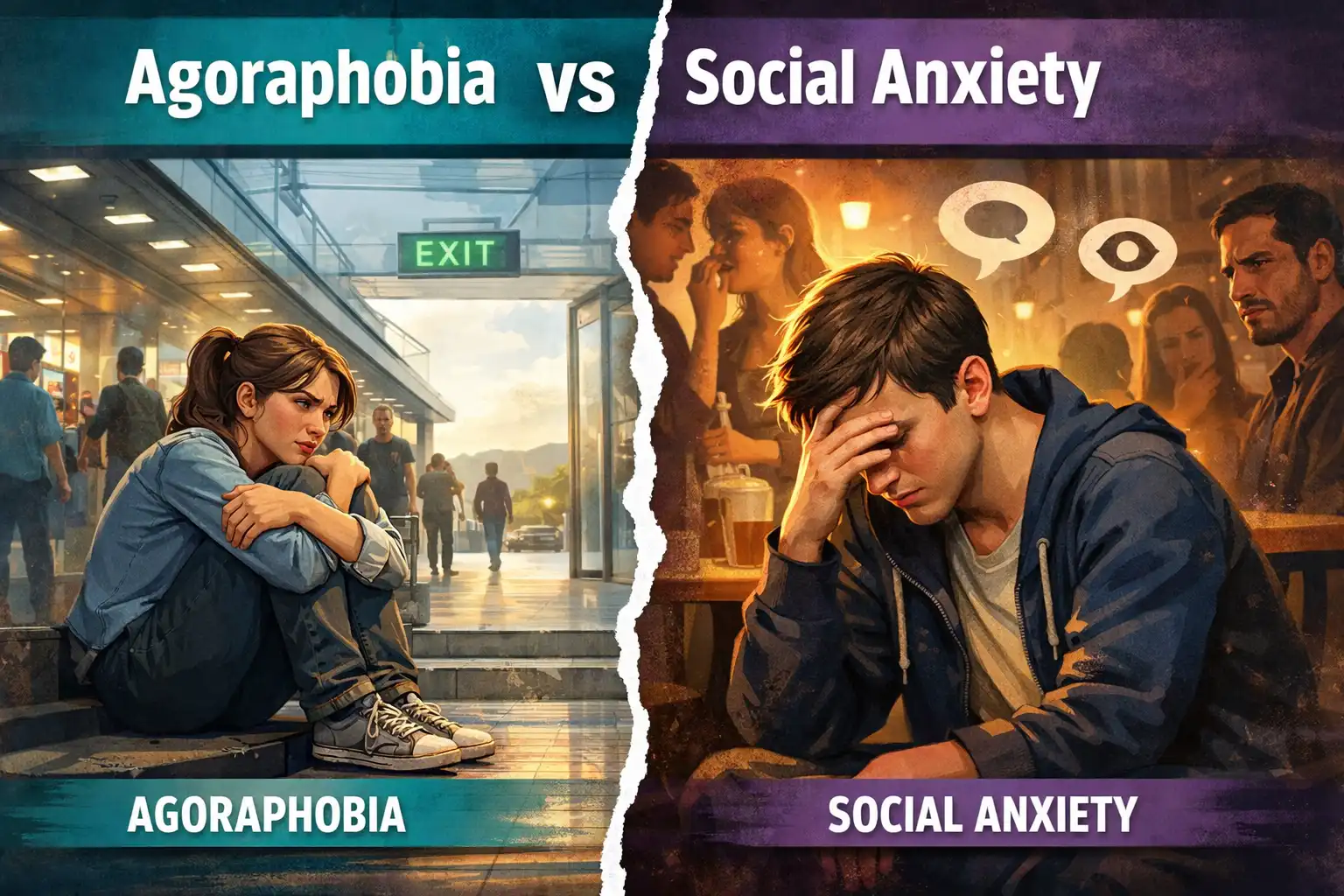

Agoraphobia vs Social Anxiety are both forms of anxiety disorders, but individuals experience them differently. Agoraphobia is the fear of situations where escape may be difficult, such as places where people gather, making it challenging to leave once you’re there. On the other hand, social anxiety is the fear of being judged or criticized in social settings. While both conditions result in avoidance behaviors, agoraphobia revolves around avoiding certain physical spaces, whereas social anxiety is more focused on the fear of negative evaluation in social interactions.
The disorders are related to one another in anxiety, but they are premised on different fears. It is very simple to mix the two. Both of them can seriously affect normal lives and render them incapable of executing regular tasks. The place of distinction is the fear itself: agoraphobia is founded on the fear of escape and social anxiety is founded on the fear of being judged. At Calm Minds Hub, we are going to talk about the distinction between agoraphobia and social anxiety. It is our mission to help you to understand and manage such difficulties in your normal life.
Agoraphobia vs Social Anxiety Disorder Symptoms
- Common Symptoms: Both agoraphobia and social anxiety disorder involve intense fear and anxiety.
- Anxiety Symptoms: People with these conditions might feel racing thoughts, sweating, and panic.
- Panic attacks can happen suddenly. This is common during social events or when escape seems hard.
- Social Avoidance: These symptoms often lead to a desire to avoid social situations as a way to manage fear.
- Fear of Judgment: In both disorders, fear is linked to intense self-consciousness about how one is perceived by others.
- Social anxiety often strikes in crowded places or during public speaking. It can cause panic and discomfort.
- Fear of judgment can make people avoid social situations. This leads to tough daily interactions.
- Understanding Differences: Spotting the subtle differences and common traits helps manage anxiety better.
Causes and Risk Factors of Agoraphobia vs Social Anxiety
Agoraphobia is normally a result of fear of being in a trap where one cannot get out. Social anxiety, on the contrary, is frequently caused by fear of being looked at or followed by those around.
Agoraphobia Causes
The factors leading to agoraphobia are normally a combination of factors. Past traumatic experiences can also increase the chances of developing agoraphobia in addition to genetic predisposition. Many of them start with a panic attack. The threat of such attacks in the open space causes people to avoid the places where they cannot easily escape. Anxiety triggers may cause agoraphobia, including stressful events and environmental changes. This makes the daily undertaking daunting.
Social Anxiety Causes
Social anxiety has certain similarities with agoraphobia, yet it is more connected with the fear of socialization. Social anxiety disorder patients are afraid of being judged or humiliated in social settings. Negative self-esteem is a major factor in this because individuals can fear being examined or mocked by other people. The biggest causes are peer pressure and the fear of social rejection. Just like in agoraphobia, anxiety and depression may co-exist, and thus it becomes difficult to treat both of them at the same time.
Risk Factors for Both Conditions
There are some risk factors of agoraphobia and social anxiety. Nevertheless, there are some significant differences between them. Mental health may be influenced by genetics and family history. Indicatively, the presence of generalized anxiety disorder (GAD) may predispose one to the development of other problems. The risk can also be increased by stressful life experiences such as trauma, abuse, or other severe anxiety-provoking events. Fear and self-pity do not always have one disorder. They are able to alter the way an individual relates to the environment and the relationship with other people.
How Agoraphobia vs Social Anxiety Is Diagnosed
The diagnosis of agoraphobia vs social anxiety is based on the differentiation of the symptoms and triggers of those disorders. Agoraphobia can be diagnosed when an individual develops a great fear of any situation where they can not easily escape, such as a crowd. This usually results in the evasion of such situations. The diagnosis of social anxiety is made when one is afraid of social contact. This terror is a result of the worry of being judged or humiliated. Both overlap with panic disorder. It is particularly so in the case of agoraphobia, where panic attacks result in avoidance. In diagnosis, psychological support and mental health care are needed. They assist in the provision of the right kind of treatment and support to the needs of the people, as it is stated in Calm Minds Hub.
Treatment Options for Agoraphobia vs Social Anxiety
CBT can be used to deal with agoraphobia. It is also used in the case of social anxiety. Another good alternative is exposure therapy. CBT assists individuals in identifying and disputing negative ideations. Exposure therapy gradually exposes them to feared situations, eliminating fears in the long run. Both treatments are aimed at reducing fear and avoidance. Additional assistance is also offered by anxiety counselling. Such methods assist individuals in reclaiming power. They can make life better. This applies to social anxiety and agoraphobia. At Calm Minds Hub, we offer resources and guidance to help you navigate these therapeutic options for better mental health and well-being.
Can Agoraphobia vs Social Anxiety Occur Together?
Social anxiety and agoraphobia are not similar but can be comorbid, leading to a complex mental health issue. Agoraphobia is the fear of being in areas where one can barely escape to get assistance. Social anxiety is the fear of being evaluated by people. Under such circumstances, a combination of these conditions can only make life tougher and complicate it. People are able to avoid the crowds of people and socialization, which contributes to loneliness and unease.
When to Seek Help for Agoraphobia vs Social Anxiety
You should also find time to think about the support of anxiety in case it is interrupting your daily life. You are avoiding social situations or places. Professional help in mental health care can come in handy. Therapy for anxiety can go a long way to overcoming the odds. A mental health specialist will assist you in case you have problems with social anxiety or agoraphobia. They offer self-help skills. They also offer personalised coping mechanisms. Early intervention is vital. With the help of the relevant assistance, the quality of life can be restored and enhanced. At Calm Minds Hub, we emphasize the importance of seeking help and provide resources to guide you on your journey to better mental health.
Final Thoughts
Social anxiety is the fear of being criticized or humiliated in social places. On the contrary, agoraphobia refers to the fear of not being able to escape places such as crowded places or social places. Your fears with social interactions usually have to be confronted in order to overcome social anxiety. This can hurt your personal relationships.
Individuals possessing either of the aforementioned conditions have a chance to enhance their mental health. They can accomplish this by addressing the issue of anxiety in a relationship. The appropriate support helps, as well. This will increase trust and ease in social places. It is important to remember that asking. Calm Minds Hub will guide you to realize and locate the path to recovery. You can take your life and relationships back again with the help of the right tools and guidance.
FAQs
Is social anxiety the same as agoraphobia?
Social anxiety and agoraphobia are different. Social anxiety is the fear of social interactions. Agoraphobia, on the other hand, is the fear of being in places where escape might be hard.
What are the two types of agoraphobia?
The two types of agoraphobia are situational agoraphobia, where fear is triggered by specific places, and generalized agoraphobia, where fear extends to a broader range of situations, often linked with social anxiety.
How do you know if you have agoraphobia?
You might have agoraphobia if you avoid certain places. This often happens because you fear panic attacks and struggle with anxiety support.