
Depression is a common mental health disorder that is experienced by millions of people annually in the world. The diagnosis and treatment of depression is only possible through good knowledge of its symptoms and categorization. The ICD-10 (International Classification of Diseases, 10th edition) codes play a critical role in the medical profession to ensure that various kinds of depression are recorded and categorized to provide a successful plan of treatment. At Calm Minds Hub, we are interested in valuable information about categorizing depression as per ICD-10, the significance of proper diagnosis and proper treatment.
What is Depression ICD 10?
ICD-10 Depression refers to a coding system that was adopted by medical practitioners to describe different types of depression. The conditions can be accurately documented with the use of these codes, and patients will be provided with the most efficient care based on the symptoms specific to their condition. The ICD-10 of depression covers a spectrum of disorders, such as major depressive episodes to persistent depressive disorders. The knowledge of these codes assists clinicians in making decisions on how to treat and assist a patient, resulting in improved outcomes.
Understanding the ICD 10 Code for Depression
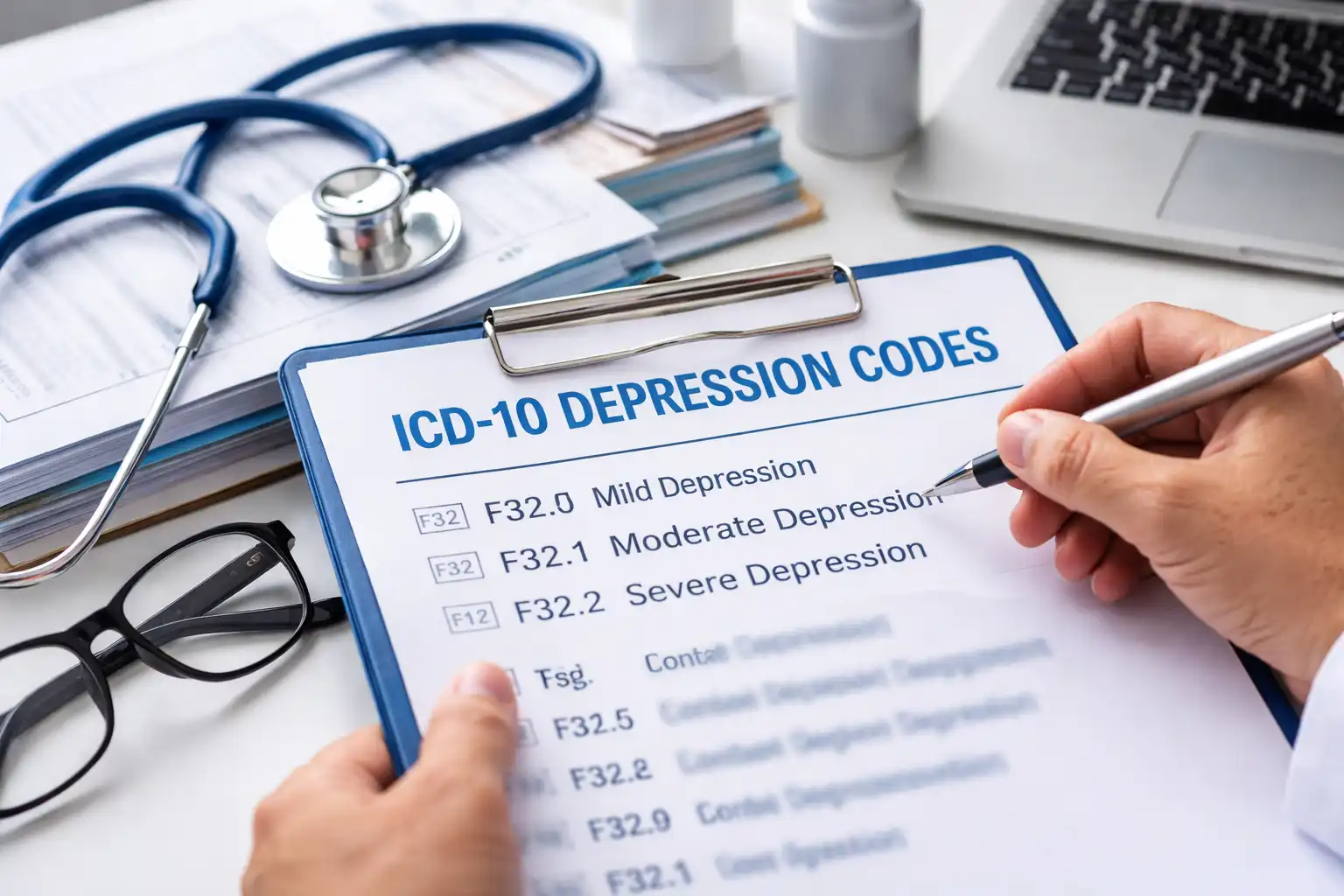
The ICD-10 code of depression is a range of depression disorder of which each type is referred to by a particular code. As an illustration, we have F32.0, which is mild depression and F32.2, which is severe depression with no psychotic elements. The classifications play a critical role as it is important in evaluating the severity of the condition and the optimal course of action that should be undertaken in the treatment. Proper coding also helps in facilitating the insurance procedure, whereby the treatment required is completed. We consider proper ICD-10 coding as a priority for quality mental care in Calm Minds Hub.
Common ICD-10 depression diagnostic categories
- The most prevalent form of depression is Major Depressive Disorder (MDD). It presents itself in a low mood and a lack of interest in daily activities.
- Recurrent Depressive Disorder: It is a disorder that causes numerous depressive episodes. It can usually be triggered by stress or significant transformations in life.
- Persistent Depressive Disorder (Dysthymia): It is a long-term and severe depression that persist at least two years.
These classes can enable medical practitioners to learn more about depression. They demonstrate the severity, duration and the cause of it. This assists in the development of individual treatment plans.
Major Depressive Disorder and ICD 10 Classification
The most widespread form of depression is Major Depressive Disorder (MDD). It causes ongoing sadness. Individuals can be exhausted and meaningless. ICD-10 of MDD is dependent on the level of severity. As an example, F32.0 relates to mild MDD and F32.2 is applied to severe MDD with no psychotic symptoms. Hallucinations or delusions are psychotic and are coded as F32.3. The availability of these details will assist patients in receiving the appropriate care. This may include treatment, a drug, or both.
Bipolar Depression ICD 10
Bipolar disorder is characterized by mania and depression. It is closely associated with depression, but should have its own ICD-10 code. Bipolar depression ICD 10 should be familiar to clinicians. They are also to be familiar with unipolar depression. The therapies are dissimilar. At Calm Minds Hub, we are more concerned with getting the diagnosis correct. This will be essential in order to prevent misclassification. It also assists us in designing good treatment plans.
Anxiety and Depression ICD 10
Anxiety and depression ICD-10 codes often go hand in hand. Many people experience both conditions at the same time. The ICD-10 code for anxiety disorders is F41.1. This code is for generalized anxiety disorder. It often pairs with depression codes. For example, F32.9 is for major depressive disorder. This dual diagnosis needs a complete treatment plan. It should include therapy and, in some cases, medication. It’s important to know how these two conditions interact. This understanding helps us create effective, personalised care at Calm Minds Hub.
Difference Between Mild, Moderate, and Severe ICD-10 Depression Codes
The intensity of the depression type is a highly significant aspect of the appropriate treatment. F32.0 is mild depression when a person can have several symptoms, such as low mood and fatigue. F32.1 is moderate depression, which has more pronounced symptoms in daily activities. Both F32.2 and F32.3 are about severe depression. F32.2 implies that there are no psychotic features. F32.3 shows there are psychotic effects like delusions or hallucinations. The right coding allows medical practitioners to reorient. This they can do depending on the severity of the condition.
Recurrent Depressive Disorder in ICD 10
Recurrent Depressive Disorder involves repeated episodes of depression. The ICD-10 code for recurrent depression includes codes like F33.0 for mild episodes and F33.3 for severe episodes with psychotic symptoms. It’s essential for clinicians to accurately track each episode to monitor the condition and adjust treatment plans. Untreated, repeated depression can lead to long-term problems. That’s why early help is so important.
Persistent Depressive Disorder (Dysthymia) under ICD-10 depression
Persistent Depressive Disorder (PDD), once called dysthymia, is a type of long-lasting depression. It lasts for at least two years. The ICD-10 code for PDD is F34.1. It involves a low mood that lasts most of the day. Other symptoms include fatigue and poor concentration. While not as severe as major depressive episodes, PDD can still have a significant impact on a person’s quality of life. At Calm Minds Hub, we support you with persistent depressive disorder. Our techniques boost your emotions.
How Healthcare Providers Use ICD 10 Code for Depression
Healthcare providers use ICD-10 codes for depression. These codes help with diagnosis. They also assist in treatment planning and billing. These codes help doctors record how severe and what type of depression a patient has. This lets them pick the best treatments. Using ICD-10 coding correctly helps insurance companies. They can process claims better. This means patients get the coverage they need for treatment. At Calm Minds Hub, we emphasize the importance of clear and accurate coding to ensure patients receive timely and effective care.
Why accurate ICD-10 depression coding matters for treatment and insurance
Accurate ICD-10 coding for depression is important. It leads to better treatment. It also helps with getting paid by insurance. Insurance companies use these codes to decide coverage. This helps ensure patients get the right care for their condition. Incorrect or vague coding, such as using F32.9 (unspecified depression), can delay treatment or lead to insurance denials. At Calm Minds Hub, we support accurate diagnosis and coding. This helps prevent problems and ensures the best care for those dealing with depression.
Final Thoughts
Understanding the ICD-10 codes for depression is vital for both healthcare providers and patients. Accurate coding ensures proper diagnosis, tailored treatment, and seamless insurance processing. Calm Minds Hub offers resources and support. If you have mild depression or recurring episodes, you can find help. Even for persistent depressive disorder, we can assist you. You can manage these challenges. If you or a loved one is struggling with depression, don’t hesitate to reach out for professional guidance and support.
FAQs
How do doctors use ICD-10 for depression diagnoses?
Doctors use ICD-10 codes to classify depression based on severity, type, and duration. This helps make personal treatment plans. It also ensures the right treatment is given.
What are the criteria for depression unspecified?
F32.9, or major depressive disorder, unspecified, is used when depression symptoms do not meet the criteria for a more specific type. This diagnosis is typically a placeholder until further evaluation is completed.
What are the diagnostic criteria for depression?
To diagnose depression, a person must have a low mood and a loss of interest in activities. They also need at least four more symptoms, such as fatigue, poor concentration, or changes in sleep and appetite. These symptoms must last for at least two weeks.