


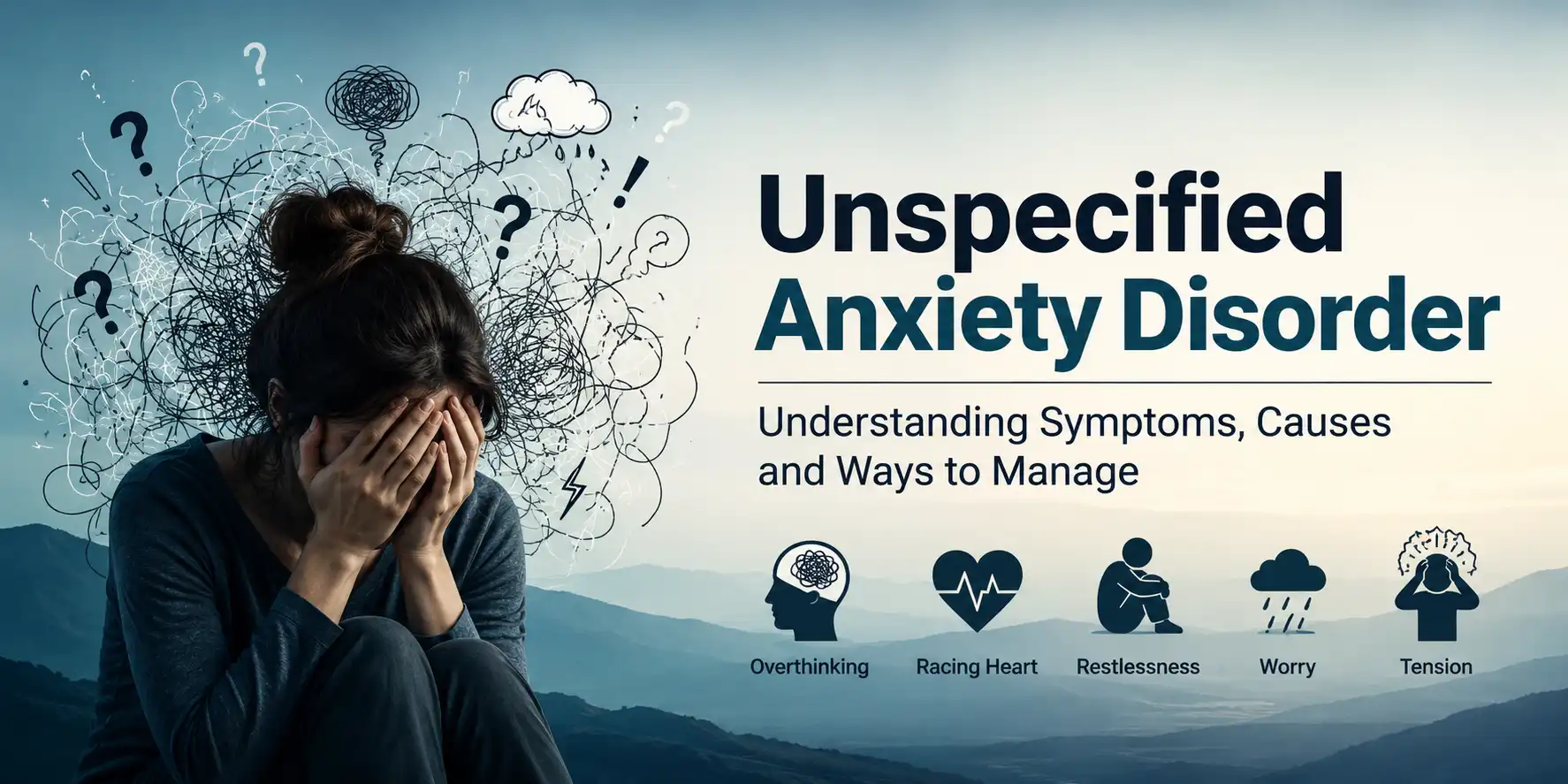

Some people wake up every morning with a heavy feeling they cannot quite name. Their chest feels tight. Their mind races over things that have not even happened yet. They worry more than they think they should, but when they finally see a doctor, the diagnosis they get is not a familiar one. The doctor calls it unspecified anxiety disorder, and suddenly they are left wondering what that even means for them.
This is more common than most people realize. Millions of people across the United States live with this exact experience. The label can feel confusing at first, maybe even a little dismissive. But it is actually a real and serious diagnosis that deserves proper attention and care. At Calm Minds Hub we created this guide to help you understand what this condition really is and more importantly how to start feeling better in your everyday life.
What Unspecified Anxiety Disorder Actually Means?
Diagnosing the patient as having an “unspecified anxiety disorder” happens when a doctor knows that they are anxious, but not experiencing enough of that anxiety disorder to meet the criteria for a specific diagnosis. There are disease-specific criteria for generalized anxiety disorder or a panic disorder. If a person’s experiences do not exactly match any of the above lists but it is evident that this person is not coping, this is the diagnosis used.
This is often included in the medical records and insurance forms with the code of F41.9 under the unspecified anxiety disorder category. The code is part of a system known for ICD-10 codes, which are used by all hospitals and clinics throughout the country. This isn’t necessarily a disposable tag. It means that anxiety disorder symptoms are actual and they are impacting your life, regardless of “what type” or whether they come in an outlined package.
How It Is Different From Other Anxiety Conditions?
The feeling of anxiety or worrying is a part of a group of feeling of anxiety illnesses known as anxiety disorder unspecified type. It is not the intensity of suffering but the sequence of symptoms that is a distinguishing characteristic. A person with the diagnosis may experience persistent fear, avoidance of situations, difficulty with sleep and physical tension almost all the time. Symptoms of these thoughts could not occur together in exactly the same pattern as it is described in a textbook for a single anxiety disorder.
It’s not a negative for the diagnosis. It simply means your fears have their own form, and open providers of health care do not want to put it in a box that it is not suited for. True honesty is a positive beginning in true therapy.
Why So Many People Go Without a Proper Diagnosis?
But in America, anxiety disorder is underdiagnosed more often than it should be. Individuals frequently take the attitude that they have a fault in their personality, and that their anxiety is merely stress caused by life. If the diagnosis they are given is not as well known as something such as depression or PTSD, they sometimes believe that their battle is too weak to bother with. So people may not even bother to get regular help for years.
If that seems familiar, it’s important to understand that you’ve been diagnosed with a mental health condition and your diagnosis is just as valid as any other mental health diagnosis. The unspecified part is not the degree to which you are suffering but rather the manner in which a presentation is delivered.
Building a Daily Routine That Gives Your Mind Some Stability
One thing that genuinely helps people with unspecified anxiety disorder is having some structure in their day. When your brain knows what is coming next, it does not have to stay on high alert all the time. That constant state of readiness is exhausting, and a predictable routine is one of the simplest ways to dial it down.
You do not need a complicated schedule. Even just waking up at the same time each day, eating meals at regular intervals, and carving out a few minutes of quiet in the morning can make a real difference. These small habits send a message to your nervous system that things are okay, that the day has a shape, and that you are in control of at least some of it.
Why Sleep Is So Important for Anxiety?
There is a complex association between sleep and anxiety. When you feel worried, it is difficult to fall asleep. Lack of sleep leads to poor anxiety management. It can feel never ending on an anxiety disorder – unspecified type. If the brain is exhausted, it doesn’t function as efficiently and the small stumbling blocks can snowball and so can the effects of common stressors.
Most people don’t need a sleep aid to sleep better. Early changes range from putting the phone away before going to bed, having a cold room, avoiding caffeine after lunch, to a consistent bedtime. Though minute changes, they may really make a difference in how well you’re able to sleep and feel emotionally balanced throughout the day over the course of several weeks.
The Kind of Therapy That Tends to Help the Most
Unspecific anxiety disorder is one of the anxiety disorder categories in which therapy continues to be one of the most successful anxiety management techniques in the long term. Out of all anxiety disorders, CBT is the most researched approach. It helps you identify your thoughts as contributors to the anxiety, and instructs you to question them. You begin to realize that all the concerns you have are the ones that your mind is making assumptions about as opposed to the facts.
As there is no one narrow behavioral strategy to tackle the anxiety disorder, unspecified, therapists have some flexibility. They can choose various strategies depending on the actual situation that is presented to you. Acceptance and Commitment Therapy (ACT), a variation of CBT much more interested in changing your thoughts but far more interested in learning not to be controlled by them, also aids some people. It helps you learn to press on despite the worries.
How Mindfulness Helps When Your Mind Will Not Slow Down?
Mindfulness is discussed everyone’s time, but it is more than just a buzzword. It has been well-researched and has been found to help people with anxiety disorder lessen the number and severity of their anxious moments. The simple concept: when you notice an worry, rather than swoop in and take it on board or respond to it, you observe it without claiming it as your own or following it.
One of the simplest ways to get started with mindfulness is to practice breathing exercise. Box breathing can be done for several minutes to help calm the nervous system, practicing this technique as you breathe in and out for 4 counts, hold for 4, exhale for 4, and hold for 4. This isn’t a matter of you having to relax. It’s all about letting your body know that there’s no emergency at this time. Calm Minds Hub suggests beginning with only one of the breathing techniques and practicing it every day for 2 weeks and then blend in other techniques later. Variety is not the primary concern here; consistency is of greater importance.
Lifestyle Habits That Actually Make a Difference
For managing anxiety disorder nothing is being used as much as exercise. It can be a little bit of time and it doesn’t need to be all that hard. In just half an hour, walk five times per week to help reduce stress hormones, sleep issues, and enhance the mood. It takes time to “catch” its effects, and it has a cumulative effect that many discover to be more than they bargained for because they move in their regular routine and their base anxiety level has been reduced.
Although it is not a widespread discussion factor in mental health, what you put into your body is important. Food high in processed food, caffeine, and sugar can contribute to increased anxiety because they can stimulate your blood sugar and keep your body constantly stressed. A few diet, hydration, and food and supplement adjustments that can benefit your brain chemistry, including increasing your intake of whole foods, water, and magnesium as well as B vitamins, can help ease anxiety symptoms from within.
Conclusion
Growing up with an unspecified member of the Anxiety Disorders group isn’t necessarily an easy task, but it doesn’t have to continue that way. These are actual methods that people employ to regain their lives—there are no quick solutions here. All of these are involved in a way that normalizes the way your nervous system reacts to the external environment, and all are part of a routine.
You need help, guidance and a way forward that is appropriate for where you are in your experience. At Calm Minds Hub we always say that finding the right support takes some patience, but it is one of the most worthwhile things you can do for yourself.
Frequently Asked Questions
What does unspecified anxiety disorder mean in plain terms?
It means you have real anxiety symptoms that a doctor cannot fit into one specific category. The diagnosis is genuine and guides real treatment, even without a more specific label.
What is the unspecified anxiety disorder code and why does it matter?
The code is F41.9 from the ICD-10 system. Doctors use it to document your condition for medical records and insurance, so your care is properly covered and tracked.
How is this different from a regular anxiety disorder diagnosis?
The difference is mostly in how the symptoms present. The anxiety and distress are just as real. The unspecified label simply means the pattern does not perfectly match one named condition.